
“I’m bad at commas.” “There are too many comma rules to remember.” “Comma rules are so wishy-washy and arbitrary.”
You’ve heard all of this, and you’ve seen how these beliefs affect student writing: from the comma splices to the missing commas that create run-on sentences to the comma confetti: commas sprinkled in wherever a student “hears a pause.”
How do we fix persistent comma errors? Below, you’ll find seven strategies to make teaching comma rules & comma errors work in your real-life classroom. I know we’re overloaded with standards in ELA, so these suggestions will work even with limited time!
Why do high school students still struggle with commas?
Many students arrive in grades 9-12 without a solid understanding of comma use: I’ve found this is true of my AP Lit students as much as it is true of my remedial and on-level students. Students who can analyze complex literature and write thoughtful essays still misuse or underuse basic punctuation all the time.
A random worksheet on a random Tuesday or two in October won’t fix it, and neither will telling the class, “Remember to proofread!” as they work on typing the final drafts of an essay. We moved away from skill-and-drill decades ago, but the new method (barely teaching grammar, usage, and punctuation at all in high school) hasn’t worked either. Students NEED explicit instruction, repeated practice, and a system they can learn and apply themselves as they make punctuation decisions independently later on.
1. Teach comma rules directly instead of hoping students will pick them up via osmosis
Students see commas every day in their reading, but exposure alone doesn’t explain WHY a comma belongs in one place and not another. If they aren’t thinking about the commas (most won’t!), they probably won’t learn HOW to use them on their own.
Take compound sentences. Without direct instruction, students often feel their way towards an idea like this: “I need to put a comma before FANBOYS (for, and, nor, but, or, yet, so).” This is a shortcut that fails because not every FANBOYS word needs a comma in front of it! We know (but students often don’t) that the rule is that a comma belongs between two independent clauses joined by a coordinating conjunction.
Correct: Maya finished her essay, and she submitted it before midnight.
Correct: Maya finished her essay and submitted it before midnight.
Incorrect: Maya finished her essay, she submitted it before midnight.
In the first sentence, both sides of “and” are independent clauses. In the second, one subject performs two actions, so “and” joins two verbs, not two independent clauses. In the third, a comma alone joins two independent clauses (a comma splice).
When students know the real rule AND the reasoning behind it, they can make informed decisions about punctuation instead of guessing or over- / under-applying a half-remembered rule or a “rule” that feels right to them. THIS is why we need to reteach and use direct instruction (even though these are grades 3-8 standards).
Try this: For every comma rule or common comma error, provide a clear explanation and explain any grammar terms they may need to know in order to fully grasp the rule/error. Then, give a correct example, an incorrect example, and a chance for students to practice. If time allows, ask them to explain, using grammar terms, why they made the punctuation choice(s) they made as you go over the answers.
2. Teach one comma rule at a time before combining skills
Comma review in high school often means doing one or two all-encompassing worksheets after a bad round of essays. But asking students to edit a paragraph or do a set of problem sentences with ten kinds of comma errors before they’ve learned (or relearned) how to spot any of them is overwhelming. Students will shut down.
It’s clear that most students do not retain these rules from grades 3-8, so a brief or rushed review probably won’t work. We need to reteach AND scaffold the learning. I start with one rule, model it, and give focused practice. Students show what they know through in-class formatives (we go over answers together), and only after doing that do I add another rule. After the key rules have been covered, I gradually combine them using more complex sentences in our later practice activities.
I begin with the rules most often tested on state tests, the ACT, and the SAT: commas in compound sentences, with introductory elements, in series/lists, and with nonessential/parenthetical elements. Then we get into the other useful rules and common misuse errors. Last, we apply what we’ve learned to more complex sentences and sentences that require several comma decisions at once.
Try this: Start with short, focused exercises. Increase the complexity only after students have edited simpler sentences, reviewed the answers as a class, and gotten feedback (and reteaching where necessary). Then, revisit each rule with mixed-rule practice and review.
[Link: See my 9 key rules by checking out the full comma unit!]
3. Teach students when NOT to use a comma
Students often start the year leaving out necessary commas and then overcorrect once you point that out, treating more commas as automatically better, but unnecessary commas damage sentences as much as missing ones do!
Remember to teach not only when TO use a comma but also when NOT to use a comma.
Consider teaching the most common over-use errors:
- Separating a subject from its verb
- Putting a comma between any two items joined by “and” or “but” (instead of only using the Oxford comma or the comma before “and” in a compound sentence)
- Separating an essential element from the word it modifies (treating it as nonessential and surrounding it with commas)
- Joining two independent clauses with only a comma (comma splice)
Incorrect: The students in my third-period class, finished their assignments early.
Correct: The students in my third-period class finished their assignments early.
The subject is “students,” and the verb is “finished.” The phrase “in my third-period class” tells us which students, so it’s essential, and nothing should come between the subject and its verb.
Try this: Include correct and incorrect sentences in both your examples and practice sentences. Sometimes give unpunctuated sentences, but also give sentences that already have commas for students to judge: is this needed, unnecessary, or misplaced? This keeps them analyzing the sentence instead of assuming every sentence needs a comma added.
4. Give students questions to ask themselves while editing
We often remind students to take time to proofread, but that feels pretty vague to most high schoolers. We must take the time to teach students HOW to proofread, yes, even in high school. Without a process they can think through, students rely on “what sounds right,” which usually means adding a comma wherever they “hear” a pause. We need to give them specific questions instead. Here are a few examples of mine:
- Compound sentences: Are there two independent clauses joined by a coordinating conjunction? Add a comma before the conjunction.
- Introductory elements: Does the sentence open with an introductory word, phrase, or clause? Add a comma after it.
- Nonessential elements: Could this extra detail be removed without changing the sentence’s basic meaning? If so, add commas. If it answers “which one?”, do not use commas.
- Unnecessary commas: Is this comma separating parts that belong together, like a subject and verb? Remove it.
- Coordinate adjectives: Can you flip the adjectives or put “and” between them? Add a comma.
Try this: Write 3-4 questions per rule, build them into your lessons, and whenever you have students explain their choices, remind them they can refer back to the questions. The goal is getting them to be able to self-check on their own while writing, editing, and taking standardized tests.
5. Use short, daily lessons instead of saving grammar for essay time
Explicit grammar instruction doesn’t need a two-week unit where you spend all period every day on grammar rules. Short, consistent lessons fit better into our already crowded curriculum, and a near-daily routine makes you far more likely to actually teach grammar instead of pushing it off until you’re out of time.
A 15-minute daily routine can look like this:
- Direct instruction: Introduce one rule and explain how it works.
- Modeling: Analyze examples together.
- Guided practice: Students apply the rule to several sentences while you lead discussion and model your thinking.
- Independent or partner practice: Students finish the practice on their own or with a buddy.
- Formative check: Go over answers, address misunderstandings, and note what to reteach tomorrow, if needed.
A routine like this can work well as bellringers or do-nows at the start of class. Students learn to open their grammar packet and either wait for you to go over the lesson OR start the next practice at the beginning of class (depending upon whether the next page is a lesson or a practice activity). I’ve found this creates a predictable routine that students appreciate.
Consistency is key. One worksheet can’t fix a skill students have struggled with for years, and we can’t rush this or skip it again when we know high school may be their last shot at mastery!
Try this: Make time for grammar at the start of each day. Focus on one comma rule per day, then review once you’ve covered each rule.
[Link: All of my grammar units are built to work as daily mini-lessons. Check them out here!]
6. Use age-appropriate, modern examples that are relatable for grades 9-12 students
If all of the practice sentences we use were obviously written for elementary school, students will often dismiss the activity as babyish. Because the comma standards appear in the Language strand for grades 3-8, we often find materials from those grades (and maybe use them without editing when short on prep time), and that can backfire… Instead, try to use topics high schoolers can relate to: school, sports, extracurriculars, friendships, music, career goals, college plans, etc.
Compare:
“Before the job interview began, Jordan reviewed her notes and did some slow breathing to steady herself.”
“After recess, Barbara’s class went to the music room.”
The first lets students focus on the introductory element without being distracted by an elementary school sentence. Custom materials MADE for high school also let you increase sentence complexity as the unit progresses. Grades 3-8 materials rarely do.
Try this: Review your current packets/worksheets/grammar materials. Do the examples fit your students’ ages, reading levels, and interests? Replace dated or childish sentences (like “Peggy’s new record player was a gift…”) with situations and names that sound like they could fit a classmate’s/siblings life.
7. Use varied formative assessments and create differentiated practice opportunities and summatives
Students who can ace a worksheet when every sentence has exactly one error often find that they are not so adept at editing a passage where not every sentence needs fixing or when they encounter a sentence where several rules apply at once. Mix up your formatives, include harder tasks as you progress through the unit, and talk through the tricky ones before the summative!
Each day, we’ll do a few sentences together, then students finish the rest alone or with a partner, and then we go over answers together. If time allows, I ask students to explain their reasoning, and if many students seem to struggle with something, I revisit it the next day.
You will also want to plan to address different needs. Consider offering:
- Extra guided or independent practice for students who need reinforcement, especially before the quiz
- Plenty of review activities for students who struggle to retain earlier rules
- More complex, multi-rule sentences for students ready for a challenge
- Multiple quiz versions for different skill levels, retakes, and makeup work
Try this: I used to wait for the unit test to find out which rules students hadn’t mastered. Now I track problems during daily practice (with a sticky note on my desk, nothing fancy) and fit reteaching in as I can so we still finish on the planned final day.
COMMA RULES FAQ
How many comma rules should I teach in high school?
I teach nine key rules, starting with the four most tested on the ACT/SAT (compound sentences, introductory elements, series, and nonessential elements) and then adding the rest.
How long should a comma lesson be?
Fifteen minutes is enough: a brief explanation, modeled examples, and time for both guided and independent practice.
Should I teach comma rules in isolation or in context?
Both! Teach one rule at a time first, then combine rules in editing practice and as applied to student writing.
How do I stop students from adding too many commas?
Teach the common misuse errors directly, and give practice sentences where students decide whether a comma is needed, unnecessary, or misplaced.
NEED A READY-TO-TEACH COMMA UNIT FOR GRADES 9-12?
My High School Comma Use Unit puts all seven strategies from this article into 30 days of 15-minute mini-lessons!

What’s included:
- 30 days of ready-to-teach mini-lessons
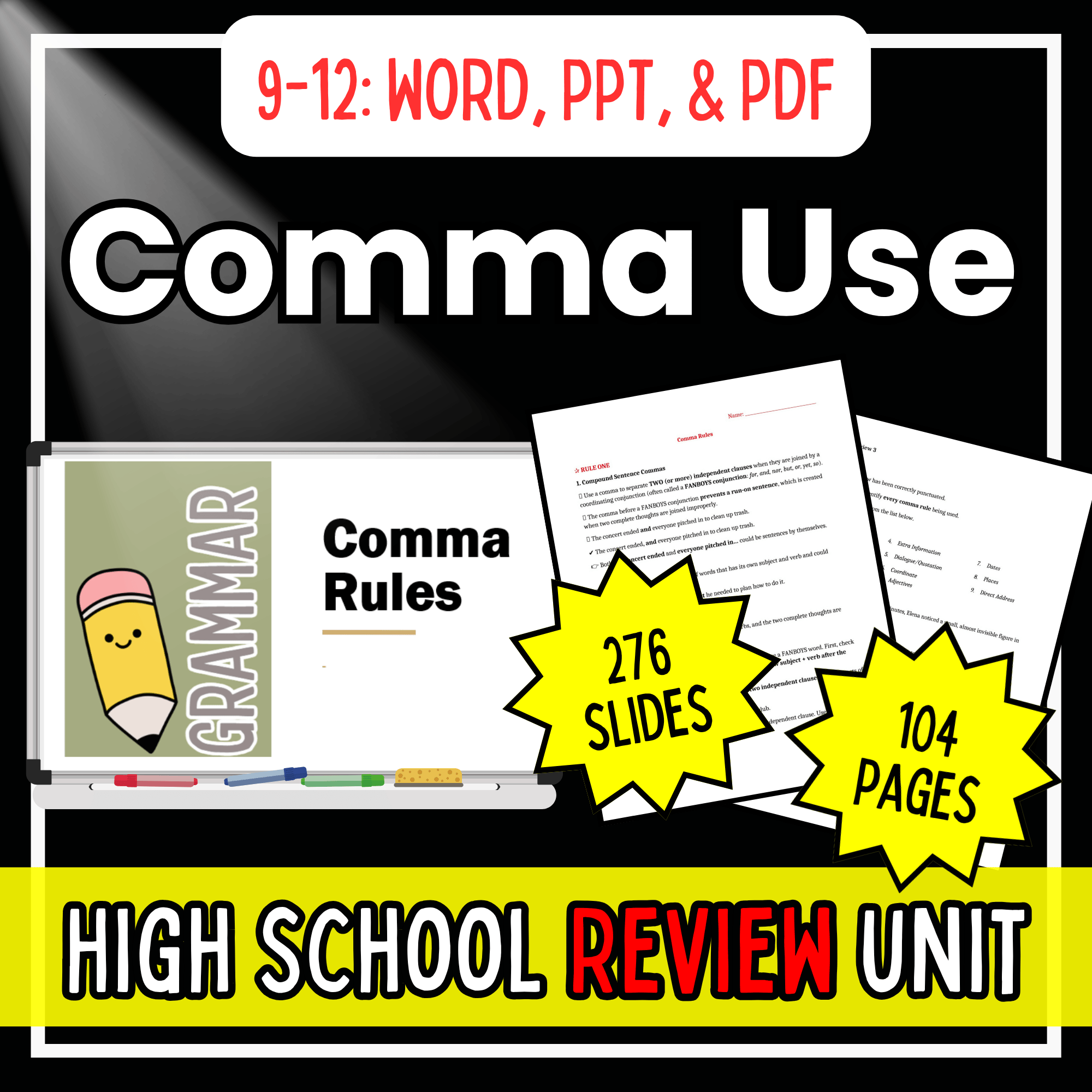
- 276 lesson slides with explanations, examples, practice, and answers
- A matching student workbook and complete answer key
- A unit calendar with pacing suggestions and teacher guidance
- 14 quiz versions (4 on-level, 9 complex, 1 modified)
- Extra practice with answer key for homework, test prep, or RTI/Tier III intervention
Rules covered: series and lists, compound sentences, introductory elements, nonrestrictive and parenthetical elements, coordinate adjectives, dialogue, dates, places, and direct address.
What you’ll love: Every example sentence is written to interest high schoolers, and the sequence works for first-time learning or as review in on-level, remedial, Honors, and AP classes. Use it as a standalone mini-unit, fold it into your grammar curriculum, or pull it out when you notice those pesky comma errors showing up in student writing!
[Explore the High School Comma Use Unit on TPT]
[Looking for more? See my full grammar curriculum here!]
THE GOAL: STUDENTS WHO UNDERSTAND THEIR PUNCTUATION CHOICES
Students shouldn’t have to guess their way through commas. With explicit instruction, focused practice, and plenty of review, they can understand commas and remember them long after the unit ends, and they can become the confident, capable writers you know they can be!
Connect with Me!
How do you find time to teach grammar, usage, and mechanics?
Share in the comments! I’d love to hear your suggestions and have my readers add to this conversation.
Follow English with Mrs. Lamp:
📷 Pinterest | 🏫 TPT Store | 📧 Email Newsletter
Related Posts:
- How to Teach Revision to High Schoolers
- Why Grammar Matters: A Rationale for Teachers
- How to Teach Phrase Types to High Schoolers
- Writing Help Page
- How to Write Your Own Teaching Philosophy






Leave a Reply