
When I first started teaching in 2011, graphic organizers were pretty simple. We didn’t have all the cool tools available now to make things pretty. Most of us were trying to use Word Docs or drawing something out by hand with a ruler & a compass to make straight & curved lines, then photocopying the worksheet. Crazy, right?
Eventually, I realized that PowerPoint could make much better, prettier worksheets, and I was off to the races! However, I started noticing a trend as everyone got their hands on tools like Canva, Publisher, and TPT Clip Art: teachers are making tools that are more about “cute” and less about how the tool serves the LEARNING purpose…
The Problem with “Pinterest-Perfect” Organizers
While visually appealing, overly designed graphic organizers for writing, to my mind, seem to create several significant problems:
- Cognitive Overload: When students face pages cluttered with decorative elements, their working memory becomes taxed with irrelevant information, leaving less mental capacity for the actual writing task.
- Lost Focus: Elaborate designs and excessive prompts shift student attention away from content development and critical thinking and toward simply “filling in blanks” without regard to the overall whole or the overall assignment & task
- Time Constraints: Complex organizers often require so much time to complete that students will then feel rushed to get through the actual writing process—defeating the purpose entirely.
- One-Size-Fits-All Limitations: Intricate organizers typically lack the flexibility needed to accommodate different learning styles and abilities within your classroom.
What Students Actually Need
The most effective graphic organizers for writing & planning share key characteristics that directly support the writing process:
- Clarity over cuteness: Simple layouts that direct attention to content rather than decoration
- Strategic space constraints: Limited room that encourages concise planning rather than premature drafting
- Focused prompts: Guidance that stimulates critical thinking without overwhelming students
- Efficient design: Two-page, front & back formats that provide structure without excessive bulk

Rethinking Our Approach
When you strip away the decorative elements and focus solely on the scaffolding students need, you’ll see dramatic improvements. Students start spending less time decoding instructions, coloring in clip art, and “over writing,” and they can focus on spending more time developing ideas. They learn to distill their thoughts rather than writing out an entire draft when they’re supposed to be planning for a draft. Most importantly, they begin to internalize organizational patterns they can apply independently.
The best part? Simple organizers require less prep time for teachers while producing better results for students. That’s a nice win, right?
A Solution That Works
After 13 years of testing and refinement, I’ve developed a collection of streamlined, two-page graphic organizers specifically designed for high school writing tasks. These organizers cover everything from argumentative essays to literary analysis, poetry explication to research papers—all without the distracting bells and whistles.
When you use SIMPLE organizers, you’ll see stronger student writing, increased student writing confidence, and a more efficient use of planning time. Instead of skipping planning and basically drafting the entire paper out on their planning pages, kids will actually DO the steps in the writing process that we’re trying to teach.
The focused, slimmed-down approach to graphic organizer creation helps struggling writers overcome anxiety while challenging advanced students to think more deeply about their writing choices.
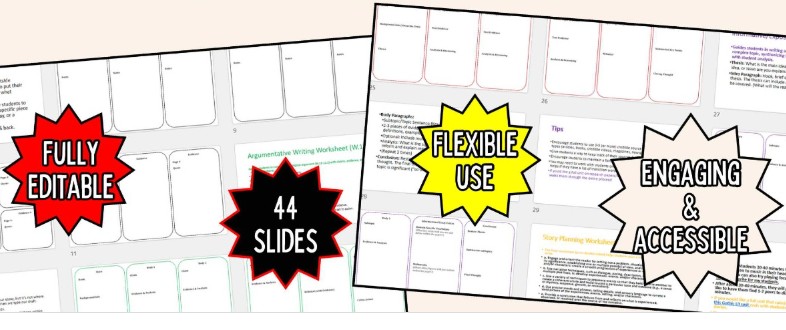
Ready to simplify your approach and strengthen your students’ writing? Check out my High School ELA Writing Graphic Organizers Pack—44 editable slides covering seven essential writing formats, all designed with clarity and purpose at the forefront.
Because sometimes, the most powerful teaching tools are the simplest ones.


Leave a Reply