
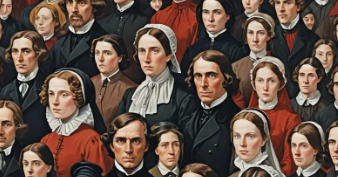

The Salem Witch Trials: A Perfect Storm of Fear, Superstition, and Social Tension
In 1692, a small Massachusetts town became the epicenter of one of the most notorious episodes of mass hysteria in American history. The Salem Witch Trials were a terrifying demonstration of how fear, religious beliefs, and social tensions could combine to create a nightmare of persecution and injustice.
Origins of the Witchcraft Hysteria
Historians have proposed multiple theories about what sparked the witch hunt. The social and environmental context of Salem Village in 1692 was complex and volatile. Economic tensions, land disputes, and ongoing conflicts between families created a powder keg of social stress. The recent wars with Native Americans, combined with a harsh winter and crop failures, had created significant community anxiety.
Some scholars suggest that the hysteria may have been partially triggered by ergot poisoning, a condition caused by a fungus that grows on rye and can cause hallucinations and convulsions. Others point to the strict Puritan belief system that saw the world as a constant battleground between God and Satan, making supernatural explanations for misfortune seem plausible.
Puritan Beliefs About Witchcraft
The Puritan worldview was fundamentally shaped by a belief in active supernatural forces. They saw witchcraft as a real and dangerous threat, believing that Satan could recruit human agents to work against God’s plan. In their interpretation, witches were not merely practicing a different religion, but actively collaborating with the devil to harm their community.
The role of ministers and published works in spreading witchcraft hysteria was significant. Prominent religious leaders like Cotton Mather and Increase Mather wrote extensively about the supernatural, providing what seemed to be scholarly and religious validation for witch-hunting. Cotton Mather’s “Memorable Providences Relating to Witchcrafts and Possessions” (1689) was particularly influential, detailing supposed witch encounters and providing a framework for identifying witches. Another crucial text was “Daemonologie” by King James I, which had been widely circulated and translated, offering a comprehensive guide to identifying and prosecuting witches.
Ministers regularly used their pulpits to reinforce these beliefs, preaching about the constant spiritual warfare between good and evil, and suggesting that witches were active agents of Satan working to undermine Christian communities. These publications and sermons created a climate of fear and suspicion, giving people a lexicon and a quasi-scientific method for understanding and identifying witchcraft. By presenting witchcraft as a real and present danger, these influential works and sermons transformed local tensions and personal conflicts into supernatural threats that demanded extreme action.
The Accusation Mechanism: Who Was Targeted?
People were more likely to be accused of witchcraft if they met certain social criteria. Marginalized individuals—often women who were poor, elderly, socially isolated, or had conflicts with powerful community members—were prime targets. Personal grudges, land disputes, and community tensions also frequently translated into witchcraft accusations.
The initial accusations began with young girls in the household of Reverend Samuel Parris. His daughter Betty and niece Abigail Williams first claimed to be afflicted by mysterious symptoms: convulsions, strange physical contortions, and apparent supernatural torment. The local doctor, William Griggs, diagnosed them as “bewitched” after traditional medical treatments failed.
Tituba, a enslaved woman from Barbados, was among the first accused. Unlike other initial suspects, she did not deny the charges. In fact, she provided elaborate confessions of supernatural activities, which paradoxically both saved her life and fueled the hysteria. Because she confessed, she was allowed to live; however, her confession made people believe the accusations were true, contributing to the continuation of the accusations, trials, and overall hysteria. Sarah Good and Sarah Osborn, by contrast, maintained their innocence. Their refusal to confess ultimately led to both of them being executed.
The Role of Spectral Evidence
Perhaps the most problematic aspect of the trials was the acceptance of “spectral evidence”—testimony about dreams, visions, and supernatural attacks that could not be independently verified. The accused could be convicted based on a witness claiming the spirit or specter of the accused person had attacked him or her, even if the physical person was elsewhere.
Notably, some legal and religious figures, including Massachusetts Governor William Phips and Minister Increase Mather, eventually spoke out against spectral evidence. Increase Mather famously wrote that it was better for ten suspected witches to escape than for one innocent person to be condemned.
Legal Consequences and Punishments
Those convicted of witchcraft were charged with the capital crime of “conjuration” or “communion with the devil.” (Capital meaning that the crime is punishable by death.) The primary punishment was execution by hanging. Nineteen people were ultimately executed, and one man, Giles Corey, was pressed to death with heavy stones for refusing to enter a plea.
The End of the Hysteria
The witch trials began to collapse under their own weight of absurdity and widespread destruction. As the accusations escalated, they started to target more prominent and respected members of the community. When the girls accused Lady Mary Phips, the wife of Governor William Phips, of witchcraft, it became a turning point. Additionally, the accusations spread to other well-connected individuals, like Margaret Jacobs, the daughter of a respected farmer, and even the wife of Reverend Increase Mather. Accusing women like these led to increased scrutiny of the girls’ accusations, and powerful people stepped in to bring an end to the entire thing.
The community’s patience wore thin as more respectable citizens found themselves under suspicion, and the economic and social fabric of Salem was being torn apart.
Governor William Phips ultimately dissolved the special Court of Oyer and Terminer (meaning “to hear” and “to determine”) in October 1692, which had been responsible for the witch trials. He later pardoned and released the remaining accused who were still imprisoned. In a dramatic turn of events, Ann Putnam Jr. would later offer a public confession and apology in 1706, admitting that her accusations had been false and expressing deep remorse for the lives destroyed.
The intervention of more rational voices also played a crucial role. Increase Mather, a prominent minister, wrote “Cases of Conscience Concerning Evil Spirits” in which he argued against the use of spectral evidence, calling for more substantial proof of witchcraft. This influential text, combined with the growing skepticism among political and religious leaders, helped bring the hysterical prosecutions to an end.
References
Primary Sources
- Mather, Cotton. Memorable Providences Relating to Witchcrafts and Possessions. Boston, 1689.
- Mather, Increase. Cases of Conscience Concerning Evil Spirits. Boston, 1693.
- Boyer, Paul, and Stephen Nissenbaum. Salem Possessed: The Social Origins of Witchcraft. Harvard University Press, 1974. (Extensive primary source research)
Academic Books
- Rosenthal, Bernard. Salem Story: Reading the Witch Trials of 1692. Cambridge University Press, 1993.
- Norton, Mary Beth. In the Devil’s Snare: The Salem Witchcraft Crisis of 1692. Vintage Books, 2002.
- Godbeer, Richard. The Devil’s Dominion: Magic and Religion in Early New England. Cambridge University Press, 1992.
Scholarly Articles
- Karlsen, Carol F. “The Devil in the Shape of a Woman: Witchcraft in Colonial New England.” The William and Mary Quarterly, vol. 35, no. 4, 1978, pp. 731-760.
- Hall, David D. “Witchcraft and the Limits of Interpretation.” The New England Quarterly, vol. 63, no. 2, 1990, pp. 253-281.
Psychological and Anthropological Studies
- Demos, John. Entertaining Satan: Witchcraft and the Culture of Early New England. Oxford University Press, 1982.
- Starr, G. A. “Puritan Theology and the Rise of Psychological Interpretation of the Salem Witch Trials.” Early American Literature, vol. 11, no. 3, 1976, pp. 282-296.
Historical Context Sources
- Ulrich, Laurel Thatcher. Good Wives: Image and Reality in the Lives of Women in Northern New England, 1650-1750. Vintage Books, 1991.
- Lockridge, Kenneth A. A New England Town: The First Hundred Years: Dedham, Massachusetts, 1636-1736. W. W. Norton & Company, 1985.
Ergot Poisoning Research
- Caporael, Linnda R. “Ergotism: The Satan Loosed in Salem?” Science, vol. 192, no. 4234, 1976, pp. 21-26.
Online Resources
- Massachusetts Historical Society. “The Salem Witch Trials, 1692-1693” Digital Collection.
- National Geographic. “What Really Happened at the Salem Witch Trials?” Online Historical Resource.







Leave a Reply